
This free sensory room safety checklist turns the safety rules in our sensory room ideas guide into a three-page printable PDF. Tick off the planning, installation, supervision, cleaning and inspection checks for a home, classroom or clinic, then keep the weekly log with your room records.
Download the checklist (PDF, 3 pages)
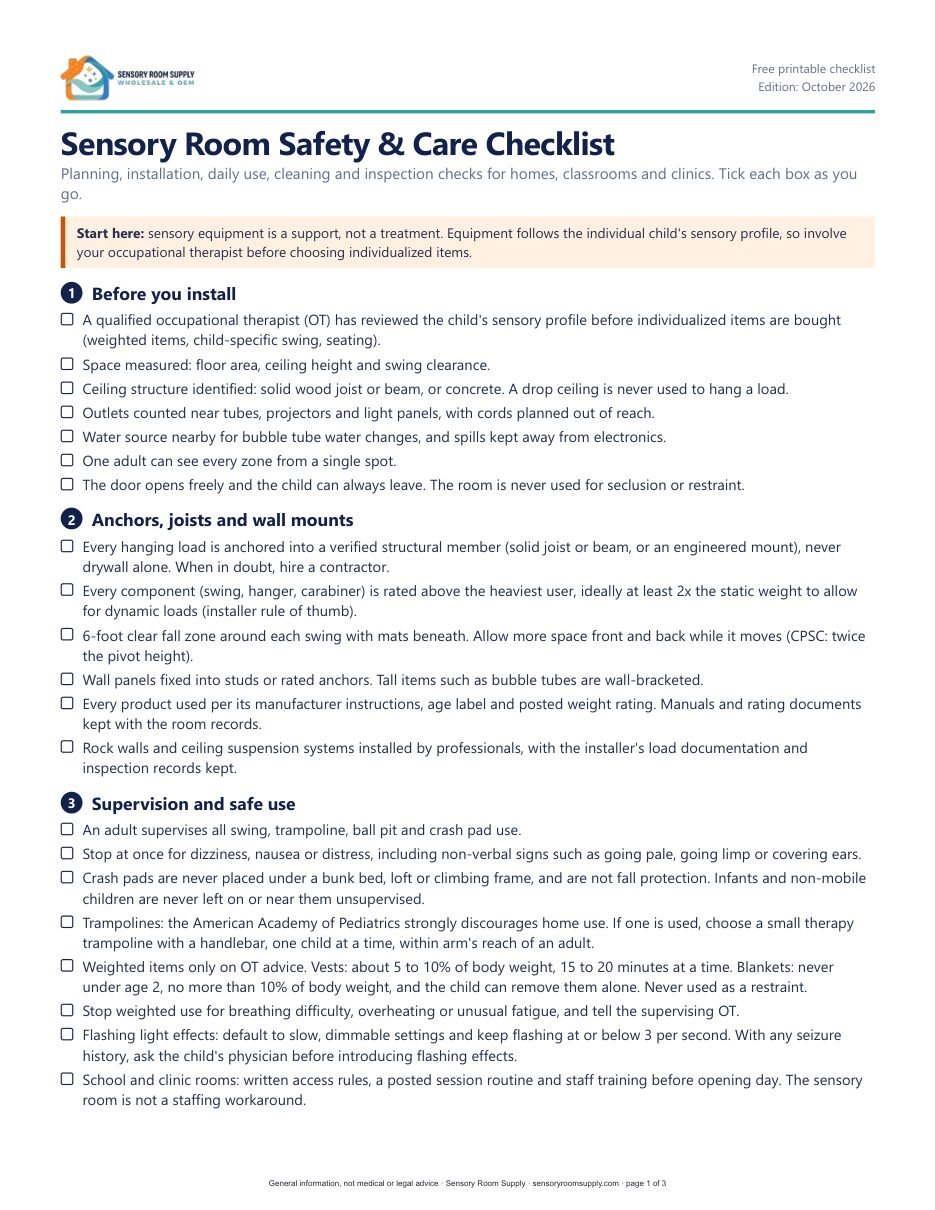
What is inside the sensory room safety checklist
- Before you install: ceiling structure, power, water, sight lines, escape route and the OT sensory profile.
- Anchors, joists and wall mounts: verified joists, rated hardware, the 6-foot fall zone and wall-bracketed tubes.
- Supervision and safe use: swings, crash pads, trampolines, weighted items and flashing lights.
- Cleaning and hygiene: ball pits, soft goods and bubble tube water changes.
- Inspection rhythm: what to check weekly, monthly and each term, plus supplier paperwork to ask for.
- A weekly inspection log and a monthly checks table you can print again and again.
Who it is for
Parents setting up a calm corner, teachers running a classroom sensory area, therapists planning a clinic room and facility managers who sign off equipment. It works for any setup, whether or not the equipment came from us.
How to use the checklist
- Print pages 1 and 2 and walk the room with them before the first session.
- Fix anything unticked, and keep the manuals and weight ratings with the printout.
- Print page 3 and log a quick weekly check. Ask an installer for anything that involves ceilings, rock walls or suspension systems.
Where the rules come from
The checklist draws on the U.S. CPSC Public Playground Safety Handbook (swing use zones), the American Academy of Pediatrics trampoline safety policy, the Shropshire NHS weighted equipment guidelines and Epilepsy Action’s photosensitivity guidance. Each rule is explained, with sources, in the care routine section of the guide.
Five sensory room safety mistakes the checklist catches
- Hanging a swing from drywall or a drop ceiling instead of a verified joist or beam.
- Checking only the swing’s weight rating, when the lowest-rated component (hook, carabiner, hanger) governs.
- Placing a crash pad under a bunk bed or loft and treating it as fall protection.
- Using a weighted blanket under age 2, or one the child cannot remove alone.
- Skipping supervision because the room “feels safe”. Every sensory room safety checklist starts and ends with an adult watching.
Working through this sensory room safety checklist before each term, and after any new equipment arrives, takes about twenty minutes and catches most of these problems.
Frequently asked questions
What should be on a sensory room safety checklist?
A good sensory room safety checklist covers planning (ceiling structure, power, water, sight lines, escape route), anchors and weight ratings, fall zones, supervision, weighted-item rules, cleaning, a weekly and monthly inspection routine, and supplier paperwork such as ASTM F963 and a Children’s Product Certificate.
How often should sensory room equipment be inspected?
Weekly: tug-test swing hardware, inspect cords, check zippers and seams on crash pads and soft goods, and sweep for small parts. Monthly: check anchors, mat and pad compression, ball cracks and age labels on new purchases. Schools and clinics should add a documented inspection each term or year.
How much space should a sensory swing have?
Allow a minimum 6-foot clear zone around the swing with floor mats beneath. The CPSC playground handbook calls for more space front and back once a swing moves, a clear zone of twice the pivot height in front of and behind a single-axis swing.
Do I need an occupational therapist to use this checklist?
No, the general safety checks apply to any sensory room. Individualized items such as weighted vests or blankets and child-specific swings should follow an occupational therapist’s recommendation for that child.
Free to print, share and link to
You can print this resource, hand it out in your classroom, clinic or parent group, and link to this page. If you republish it, please credit Sensory Room Supply and link to sensoryroomsupply.com/free-resources/. Please do not sell it or remove the credit line.
Planning a school, clinic or resale range? We supply sensory room equipment in bulk with OEM options. Request a quote or see equipment for schools and clinics.
More free resources and guides
- Sensory room budget planner (Excel)
- Sensory room cost infographic
- Sensory Room Ideas: the complete room-by-room planning guide
- Sensory room equipment checklist for schools, clinics and resellers
General information for planning only. It is not medical, occupational-therapy, psychological or legal advice. Manufacturer instructions, age labels and your clinician’s guidance always govern.